La voce di Lawrence
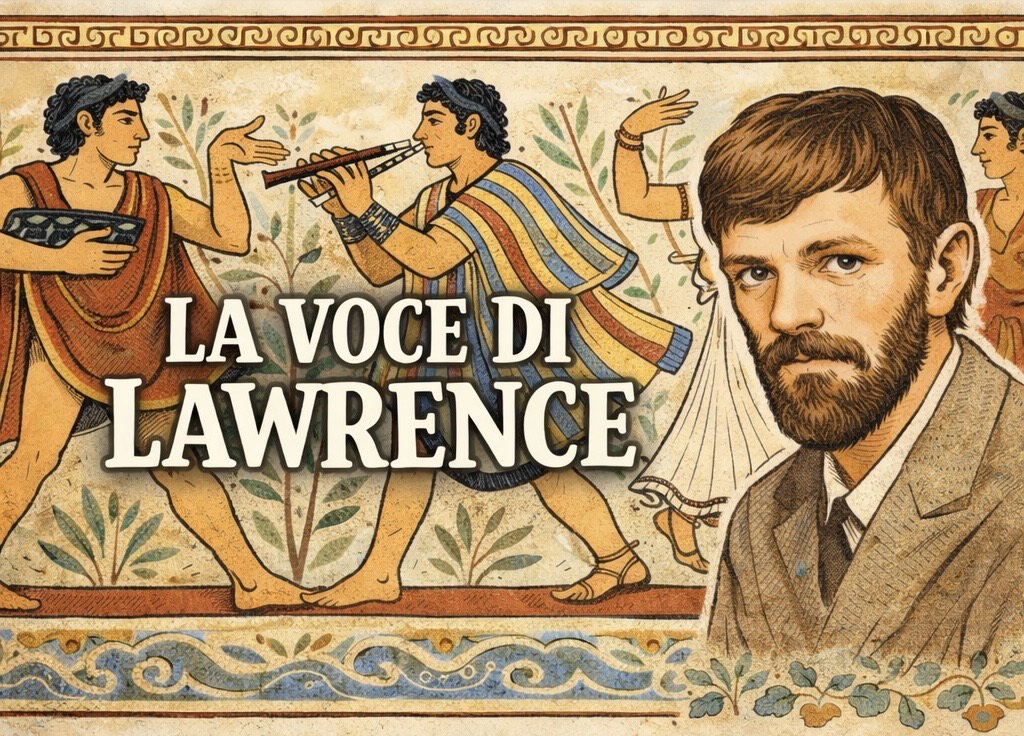
Passaggi tratti da Etruscan places (1932) di David Herbert Lawrence
“We soon saw Tarquinia, its towers pricking up like antennae on the side of a low bluff of a hill, some few miles inland from the sea. And this was once the metropolis of Etruria, chief city of the great Etruscan League. But it died like all the other Etruscan cities, and had a more or less mediaeval rebirth, with a new name. Dante knew it, as it was known for centuries, as Corneto—Corgnetum or Cornetium—and forgotten was its Etruscan past. Then there was a feeble sort of wakening to remembrance a hundred years ago, and the town got Tarquinia tacked on to its Corneto: Corneto-Tarquinia.”
~ ~ ~
“[T]he top is a fragment of public garden, and a look-out. Two old men are sitting in the sun, under a tree. We walk to the parapet, and suddenly are looking into one of the most delightful landscapes I have ever seen: as it were, into the very virginity of hilly green country. It is all wheat—green and soft and swooping, swooping down and up, and glowing with green newness, and no houses. Down goes the declivity below us, then swerving the curve and up again, to the neighbouring hill that faces in all its greenness and long-running immaculateness. Beyond, the hills ripple away to the mountains, and far in the distance stands a round peak, that seems to have an enchanted city on its summit.
Such a pure, uprising, unsullied country, in the greenness of wheat on an April morning!—and the queer complication of hills! There seems nothing of the modern world here—no houses, no contrivances, only a sort of fair wonder and stillness, an openness which has not been violated.
The hill opposite is like a distinct companion. The near end is quite steep and wild, with evergreen oaks and scrub, and specks of black-and-white cattle on the slopes of common. But the long crest is green again with wheat, running and drooping to the south. And immediately one feels: that hill has a soul, it has a meaning.
Lying thus opposite to Tarquinia’s long hill, a companion across a suave little swing of valley, one feels at once that, if this is the hill where the living Tarquinians had their gay wooden houses, then that is the hill where the dead lie buried and quick, as seeds, in their painted houses underground. The two hills are as inseparable as life and death, even now, on the sunny, green-filled April morning with the breeze blowing in from the sea. And the land beyond seems as mysterious and fresh as if it were still the morning of Time.”
~ ~ ~
“… Then this hill is the necropolis hill! The Etruscans never buried their dead within the city walls. And the modern cemetery and the first Etruscan tombs lie almost close up to the present city gate. Therefore, if the ancient city of Tarquinia lay on this hill, it can have occupied no more space, hardly, than the present little town of a few thousand people. Which seems impossible. Far more probably, the city itself lay on that opposite hill there, which lies splendid and unsullied, running parallel to us.
We walk across the wild bit of hilltop, where the stones crop out, and the first rock-rose flutters, and the asphodels stick up. This is the necropolis. Once it had many a tumulus, and streets of tombs. Now there is no sign of any tombs: no tumulus, nothing but the rough bare hill-crest, with stones and short grass and flowers, the sea gleaming away to the right, under the sun, and the soft land inland glowing very green and pure.”
“The bit of wall we see is a little hood of masonry with an iron gate, covering a little flight of steps leading down into the ground. One comes upon it all at once, in the rough nothingness of the hillside. The guide kneels down to light his acetylene lamp, and his old terrier lies down resignedly in the sun, in the breeze which rushes persistently from the south-west, over these long, exposed hilltops.
The lamp begins to shine and smell, then to shine without smelling: the guide opens the iron gate, and we descend the steep steps down into the tomb. It seems a dark little hole underground: a dark little hole, after the sun of the upper world!”
~ ~ ~
“There are many tombs. When we have seen one, up we go, a little bewildered, into the afternoon sun, across a tract of rough, tormented hill, and down again to the underground, like rabbits in a warren. The hilltop is really a warren of tombs. And gradually the underworld of the Etruscans becomes more real than the above day of the afternoon. One begins to live with the painted dancers and feasters and mourners, and to look eagerly for them.”
~ ~ ~
“There is a haunting quality in the Etruscan representations. Those leopards with their long tongues hanging out: those flowing hippocampi; those cringing spotted deer, struck in flank and neck; they get into the imagination, and will not go out. And we see the wavy edge of the sea, the dolphins curving over, the diver going down clean, the little man climbing up the rock after him so eagerly. Then the men with beards who recline on the banqueting beds: how they hold up the mysterious egg! And the women with the conical head-dress, how strangely they lean forward, with caresses we no longer know! The naked slaves joyfully stoop to the wine- jars. Their nakedness is its own clothing, more easy than drapery. The curves of their limbs show pure pleasure in life, a pleasure that goes deeper still in the limbs of the dancers, in the big, long hands thrown out and dancing to the very ends of the fingers, a dance that surges from within, like a current in the sea. It is as if the current of some strong different life swept through them, different from our shallow current to-day: as if they drew their vitality from different depths that we are denied.”
~ ~ ~
“We have passed the modern cemetery, with its white marble headstones, and the arches of a mediaeval aqueduct mysteriously spanning a dip, and left the highroad, following a path along the long hill-crest, through the green wheat that flutters and ripples in the sea- wind like fine feathers, in the wonderful brilliance of morning. Here and there are tassels of mauve anemones, bits of verbena, many daisies, tufts of camomile. On a rocky mound, which was once a tumulus, the asphodels have the advantage, and send up their spikes on the bright, fresh air, like soldiers clustered on the mount. And we go along this vivid green headland of wheat—which still is rough and uneven, because it was once all tumuli—with our faces to the breeze, the sea-brightness filling the air with exhilaration, and all the country still and silent…”